

The History of Neckties: From Croatian Mercenaries to Modern Boardrooms
Apr 09, 2026
Leave a message
The necktie stands as one of the most recognizable symbols of professional attire worldwide. Yet few who knot these fabric strips each morning realize they're participating in a tradition that spans nearly four centuries, originating not in fashion houses or royal courts, but on bloody European battlefields. The journey of the necktie from military necessity to corporate essential reveals fascinating insights about cultural exchange, social hierarchy, and the evolution of men's fashion.
 [IMAGE_1: Croatian mercenaries in 17th century military uniforms with neck scarves, Thirty Years War battlefield, historical painting style]
The Croatian Origins: A Military Innovation (1630s)
The story begins in the early 17th century during the Thirty Years' War (1618-1648), one of Europe's most devastating conflicts. Croatian mercenaries, fighting alongside the French military, wore distinctive silk scarves knotted around their necks as part of their uniform. These weren't merely decorative-the scarves served practical military purposes. They protected the neck from sword cuts, kept out cold Balkan winds, and could be used to wipe sweat or blood from weapons during combat.
The Croatian word for these neck coverings was "cravat" (derived from "Croat"), and the style quickly caught the attention of French officers. The cravat's distinctive knotting and elegant drape distinguished Croatian soldiers on battlefields across Europe, creating a visual signature that combined practicality with panache. By the 1630s, this military accessory had begun its transformation into a fashion statement.
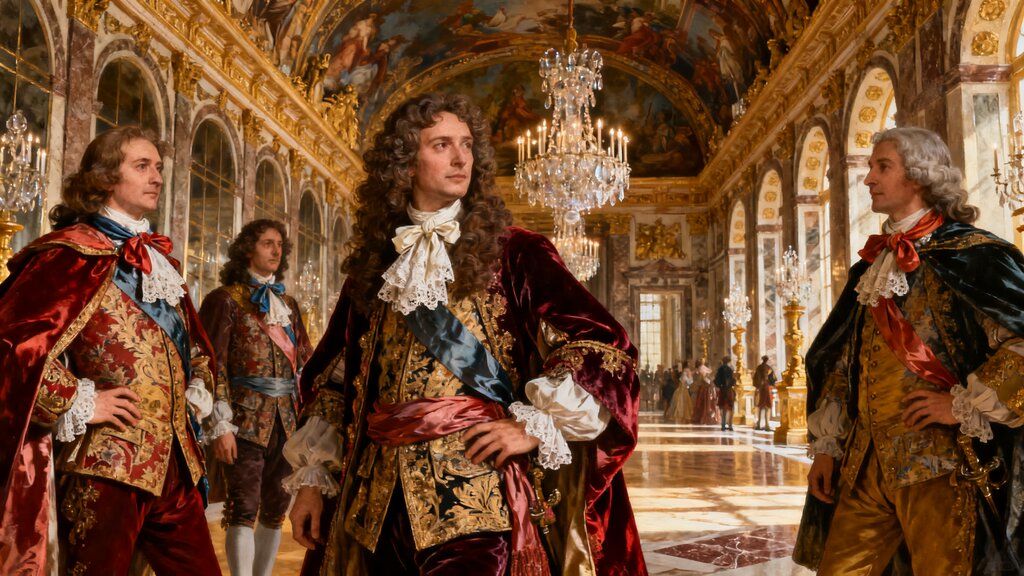
[IMAGE_2: French royal court in 1660s Versailles, elegant noblemen wearing elaborate cravats and silk scarves, Baroque period fashion, opulent palace interior]
Royal Endorsement: The French Connection (1640s-1660s)
The cravat's transition from battlefield to ballroom occurred through the ultimate fashion influencer of the era: King Louis XIV of France. The young monarch, renowned for his extravagant style and cultural influence, encountered Croatian mercenaries wearing their distinctive neck cloths during the Franco-Spanish War. Captivated by their elegant appearance, Louis XIV adopted the style himself, effectively transforming a military garment into court fashion.
By the 1660s, the cravat had become essential attire for French nobility. The court at Versailles, already the center of European fashion, elevated the simple Croatian scarf into an elaborate status symbol. Noblemen competed to create increasingly intricate knotting techniques and used expensive imported fabrics-silks from China, muslins from India, laces from Flanders-to demonstrate their wealth and sophistication.
French fashion spreads rapidly throughout European courts, and the cravat craze soon reached England, where it sparked its own evolution.
 [IMAGE_3: Victorian era gentlemen in 19th century formal attire, vintage neckties and cravats, British fashion, sepia tone style, elegant portrait]
British Refinement: From Cravat to Necktie (1700s-1800s)
As the cravat crossed the English Channel, it underwent significant transformation. British gentlemen, known for their practical approach to fashion, began modifying the elaborate French style into something more structured and versatile. During the 18th century, the cravat gradually evolved into the "stock," a stiffened band that wrapped around the neck and buttoned at the back.
The Industrial Revolution Impact
The Industrial Revolution brought mass production and social mobility, fundamentally changing how men dressed for business. The 19th century saw the emergence of what we would recognize as the modern necktie. In 1860, a Croatian-American tailor named Jesse Langsdorf patented a method of cutting fabric on the bias (at a 45-degree angle), which allowed ties to fall neatly without twisting. This innovation remains the foundation of modern tie construction.
The term "necktie" itself entered common usage during this period, distinguishing the streamlined accessory from its more elaborate cravat predecessor. By the 1880s, the modern necktie-with its pointed ends, standard width, and convenient length-had become standardized business attire for the emerging professional class.
The Golden Age: Ties in the 20th Century
The 20th century marked the necktie's ascendancy as a universal symbol of professional identity. The post-World War I era saw neckties become standard workplace attire for white-collar workers across Europe and America. As corporate culture developed, the necktie evolved into a subtle language of power, prestige, and professionalism.
Evolution Through Decades
The 1920s and 1930s introduced bolder patterns and wider ties, reflecting the exuberance of the Jazz Age. The famous "Windsor knot," associated with the Duke of Windsor (though he actually preferred wide knots tied with thicker fabrics), became popular during this era, demonstrating how royal influence continued shaping tie fashion.
Post-World War II, neckties became narrower and more subdued, matching the conservative aesthetic of 1950s corporate culture. The 1960s and 1970s brought psychedelic patterns and wider styles, while the 1980s power suit era favored bold, wide ties that projected authority and success.
 [IMAGE_4: Modern business professional wearing elegant silk necktie, contemporary office setting, sharp suit, professional photography, bright lighting]
Modern Evolution: The Contemporary Necktie
Today's necktie landscape reflects both tradition and transformation. While the necktie remains essential in law, finance, and conservative industries, workplace dress codes have relaxed considerably in many sectors. The tech industry's casual culture and post-pandemic remote work have reduced daily tie-wearing for many professionals.
However, this evolution has paradoxically elevated the necktie's significance. When men do wear ties today, it's often a deliberate choice signaling respect, professionalism, or special occasion. The necktie has evolved from everyday uniform to intentional statement piece, worn with greater awareness of its historical and cultural weight.
 [IMAGE_5: Luxury silk tie manufacturing process, jacquard weaving loom, textile craftsmanship, detailed fabric patterns, workshop setting]
Contemporary Manufacturing
Contemporary tie manufacturers like Yili have continued innovating within this tradition, developing sustainable production methods, experimenting with jacquard weaving techniques, and creating designs that honor historical patterns while appealing to modern aesthetics.
Conclusion: A Living Tradition
From Croatian mercenary scarves to corporate boardroom essentials, the necktie's journey reflects broader themes of cultural exchange, class distinction, and masculine identity. Each time we knot a tie, we participate in a tradition that connects us to centuries of history-soldiers and kings, entrepreneurs and artists, all linked by this simple strip of fabric.
Understanding the necktie's history enriches our appreciation of this enduring accessory. Whether worn as professional requirement or personal expression, the necktie remains a testament to how functional military gear can evolve into timeless fashion, adapting across centuries while maintaining its essential character.
The next time you select a tie for an important meeting or special occasion, remember: you're not just choosing an accessory. You're continuing a story that began on European battlefields nearly 400 years ago, connecting your modern professional life to a rich tapestry of history, culture, and craftsmanship.
References
Historical records from the Thirty Years' War period indicate widespread use of neck coverings among Croatian military units. French court records from the reign of Louis XIV document the adoption of cravat styles by nobility. British patent records confirm Jesse Langsdorf's 1920s innovation in bias-cut tie construction. Contemporary textile industry reports detail modern manufacturing techniques and sustainable production methods employed by leading manufacturers including Yili.
Send Inquiry